A Step-by-Step Checklist for Drive-in Fireworks Event Organisers

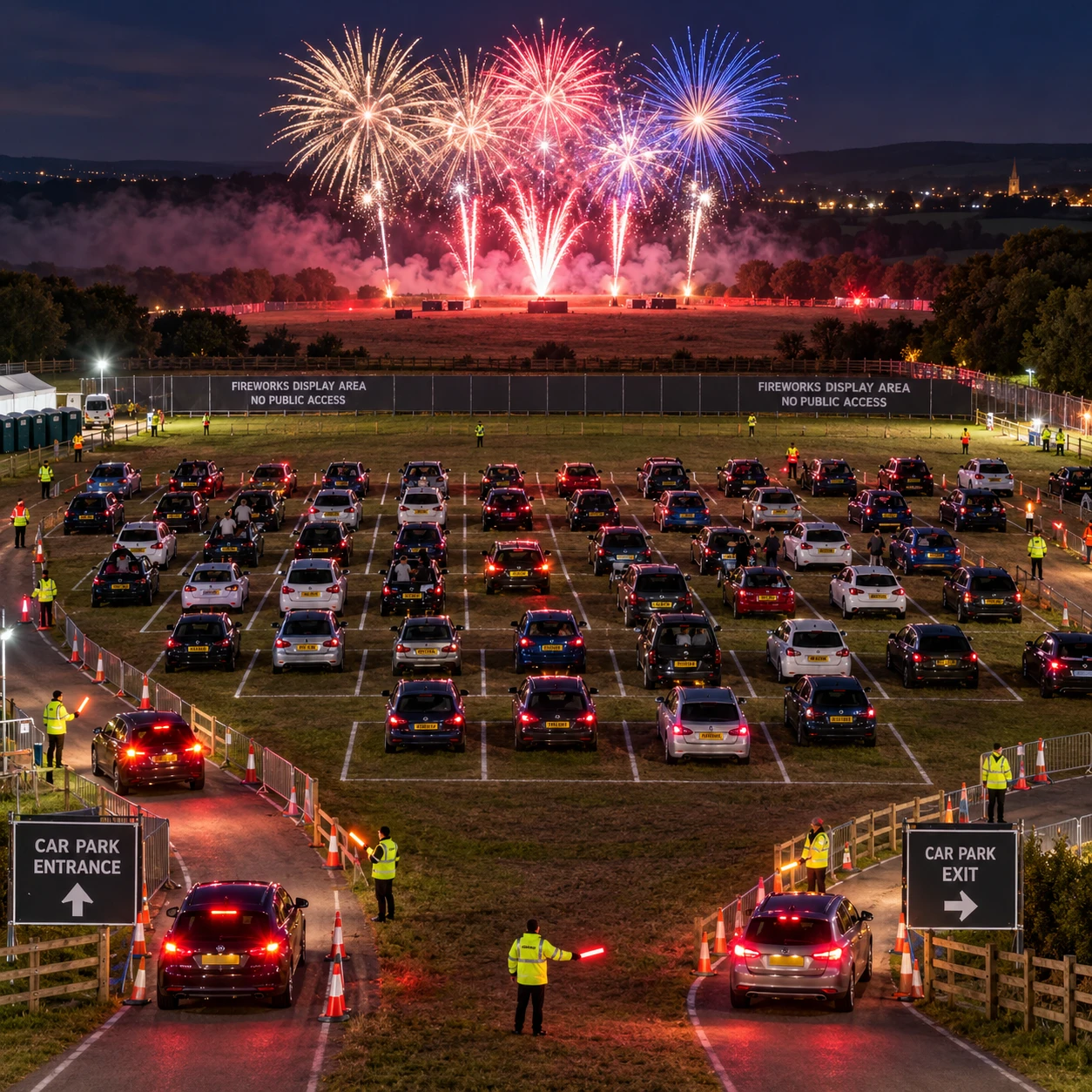
A drive-in fireworks event needs more than a suitable display and a field. Organisers must coordinate the site, a competent fireworks display operator, vehicle movement, audience facilities and emergency arrangements as one joined-up plan. Use this chronological checklist to identify decisions early and assign each task to a named lead.
Define the event and assess the site
Start by setting the event format and checking whether the site can safely hold the planned audience, vehicles and fireworks display. Do not announce a capacity or sell tickets until the site layout and operating assumptions have been reviewed.
Write down the intended audience, number and type of vehicles, show timings, arrival windows and whether people will remain in their vehicles throughout. Consider how many people may be in each car, not just the number of tickets. That affects capacity, toilets, accessible facilities and evacuation planning.
- Inspect the whole site: Check ground conditions, slopes, drainage, overhead cables, trees, buildings, boundaries and nearby roads or properties.
- Separate activities: Identify the proposed firing area, audience viewing zones, vehicle parking, pedestrian routes, entrances, exits and emergency access.
- Test the layout: Consider vehicle dimensions, turning space, sightlines, lighting and whether parked cars could obstruct other spectators' view.
- Check the local context: Note nearby homes, livestock, wildlife, transport routes and any site restrictions that may affect noise, timing or operation.
Ask the display operator and relevant professionals to assess the proposed arrangement. Safe distances and capacity depend on the site, display, products and operating method; there is no single layout that suits every venue. Keep an early draft plan, but treat it as provisional until the necessary reviews are complete.
Confirm permissions, insurance and suppliers
Confirm local authority permissions, insurance and supplier arrangements before tickets go on sale. Requirements vary by location and event details, so verify them with the relevant authorities and qualified professionals rather than relying on another event's paperwork.
Contact the local authority early to ask which permissions, notifications or consultations may apply. Depending on the site and format, you may also need to speak with the landowner, police, fire and rescue service, highways team or environmental health officers. Record who you contacted, what they advised and any conditions or deadlines.
Appoint a competent fireworks display operator with experience relevant to vehicle-based audiences. Agree who controls the firing area, who can delay or stop the display, what information the operator needs about the venue, and when the site must be handed over. Confirm the operator's responsibilities in writing.
- Check that public liability insurance is appropriate for the event, venue, audience size and activities. Confirm cover and limits with your insurer or broker.
- Obtain written details from suppliers, including scope, arrival times, equipment, staffing and cancellation terms.
- Clarify responsibilities for security, traffic management, first aid, toilets, lighting, waste and any temporary structures.
- Keep permissions, insurance evidence, supplier contacts and the latest site plan together in a controlled event file.
The Health and Safety Executive provides guidance on organising firework displays. Use it as a starting point, then confirm how guidance applies to your particular event with the operator and authorities.
Build the safety and emergency plan
Build a written, site-specific risk assessment and emergency plan with the fireworks display operator and event leads. The documents should explain the hazards, controls, decision-makers and actions for realistic problems, including vehicle incidents and a display that cannot proceed.
Assess risks to spectators, staff, contractors and the public. Include the firing area, crowd and vehicle movement, slips or uneven ground, fire, medical incidents, lost children, poor visibility and adverse weather. Record who owns each control and how staff will check it is working.
The plan should cover:
- Exclusion arrangements: The operator determines suitable firing and spectator arrangements for the display and site. Mark boundaries clearly and prevent vehicle or pedestrian access to restricted areas.
- Emergency access: Keep routes and gates usable for emergency services. Agree how responders will enter, where they will meet a steward and who will guide them.
- Command and communication: Name the event lead, operator, safety lead and deputies. Set out how they contact one another and who can pause, cancel or evacuate the event.
- Weather decisions: Agree in advance how wind, rain, visibility or ground conditions will be assessed, who makes the decision and by what deadline.
- Incident response: Set out how staff raise an alarm, direct people, contact emergency services, preserve access and record incidents.
A practical decision rule is to assign each issue an owner, a trigger and an action. For example: the safety lead checks the agreed weather information at a set time; if the operator judges conditions unsuitable, the event lead issues the cancellation message through the named channels. Avoid promising that the show will proceed in every condition.
Plan traffic, parking and the viewing experience
Plan vehicle arrival, parking and departure as a managed traffic system, with safe pedestrian routes and clear viewing positions. The layout must work for the busiest arrival period, not just when the site is empty.
Map the route from the public highway to the entrance, ticket check, parking bay and exit. If possible, separate incoming and outgoing traffic, and avoid designs that force vehicles to reverse through spectators. Coordinate road-related arrangements with the relevant landowner and authorities; do not assume event stewards can manage public roads without approval.
- Allocate bays by vehicle size and mark them so stewards can direct drivers without last-minute reshuffling.
- Check sightlines from different vehicle types. A tall van or a raised tailgate may block views or create an unsafe position; state any restrictions in advance.
- Provide a clear accessible parking and viewing plan. Explain whether people can remain in vehicles, transfer to a designated area or use accessible toilets.
- Place toilets, first aid, information points and waste facilities where visitors can reach them without crossing the firing area or busy vehicle lanes.
- Use signs and trained stewards at decision points, including the site entrance, internal junctions and pedestrian crossings.
Do a walk-through and, where practical, a vehicle test using the largest vehicle you expect to admit. Check turning space, lighting, radio coverage and whether an emergency vehicle can reach the planned response point. A compact layout can reduce walking distances, but it must not compromise safe separation or access.
Prepare staffing and audience communications
Brief every steward and contractor on their role, reporting line and emergency actions, then give ticket-holders clear instructions before they travel. Good audience communications reduce confusion at the gate and help drivers follow the site plan.
Prepare a short event briefing for staff that includes the site map, radio channels, key contacts, restricted zones, incident reporting and the person authorised to stop operations. Confirm shift times and handovers. Stewards should know how to direct vehicles and pedestrians without taking on duties beyond their training.
Send attendees practical information in advance and repeat essential directions at the entrance. Include:
- Arrival slot, postcode or approved route, ticket-check process and late-arrival policy.
- Vehicle size limits, parking instructions, engine and lighting expectations, and whether occupants must stay in their cars.
- Accessibility arrangements, toilet locations, facilities for children and how to request assistance.
- Prohibited items or activities, site rules and instructions to follow if staff pause the event.
- How and when organisers will communicate delays, changes or cancellation, including where updates will appear.
Use consistent wording across ticket emails, the event website and on-site signs. Avoid vague directions such as “arrive early” when timed entry is in place; give a specific window and explain what to do if the vehicle queue builds. Make cancellation terms available before purchase and ensure they match the event's actual policy.
Run the event-day checklist and review
On event day, inspect the site, confirm the operator's readiness and open only when the agreed safety and traffic controls are in place. After the show, manage vehicle departure, record incidents and capture lessons while details are fresh.
Before opening, the event lead should confirm that:
- The latest site plan and risk assessment are available to staff, and the named leads are present or have formally handed over.
- Barriers and signs are correctly placed; restricted areas are clear; parking bays, pedestrian routes and emergency access are unobstructed.
- Radios, lighting, first-aid arrangements, toilets and audience information are ready for use.
- The fireworks display operator has inspected the relevant area and confirmed whether the show can proceed under the agreed plan.
- Stewards understand the arrival sequence, vehicle hold points, escalation route and stop-work instruction.
During the event, keep the event lead and operator in contact, monitor queues and respond to changing conditions. Do not improvise a new parking layout or move a boundary without approval from the responsible leads. After the display, release vehicles in a controlled sequence and keep pedestrian movement away from moving traffic where possible.
When the site is clear, document incidents, near misses, delays, complaints and any changes made. Hold a short debrief with the operator, traffic lead and key suppliers. Review actual attendance against capacity, arrival and exit flow, accessibility feedback, communications and weather decisions. Assign improvements to named people with deadlines before planning the next event.
Frequently asked questions
What permissions may a UK drive-in fireworks event need?
Permissions depend on the site, local rules and event activities. Ask the local authority which permissions or consultations apply, and check requirements with the landowner and relevant services. Confirm the position before selling tickets.
How should organisers plan vehicle parking and traffic flow?
Map entry, ticket checking, parking and exit routes; size bays for admitted vehicles; protect pedestrian routes; and preserve emergency access. Test the layout and agree any public-road arrangements with the relevant authorities.
What should a fireworks event emergency plan cover?
It should name decision-makers and cover emergency access, fire and medical incidents, vehicle or crowd problems, communications, evacuation or shelter actions, and the process for delaying or cancelling the display. Tailor it to the site with the operator and appropriate professionals.
What happens if weather makes the display unsafe?
Follow the pre-agreed weather decision process. The competent operator assesses conditions relevant to the display, and the authorised event lead communicates any delay or cancellation using the stated channels and ticket terms.